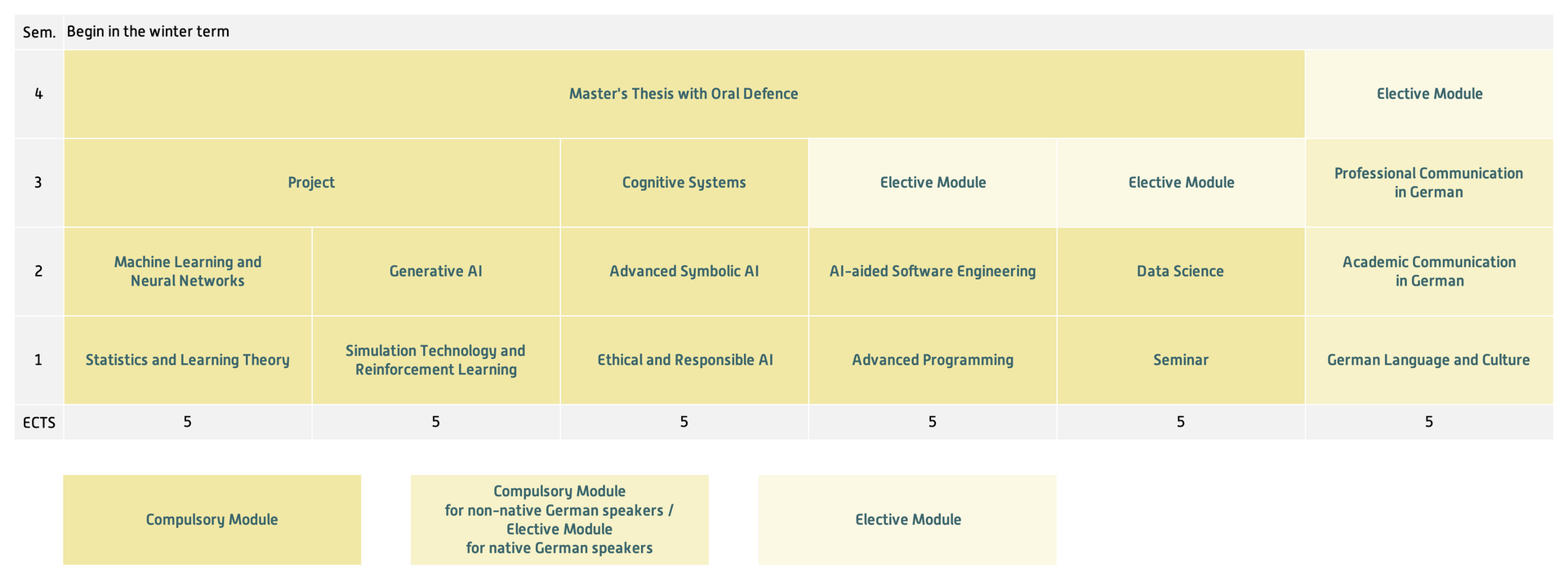
The rapid development of artificial intelligence is fundamentally transforming business, science and society. AI-based methods are increasingly becoming a key technology that influences almost all areas of computer science as well as numerous fields of application. At the same time, there is a growing demand for highly qualified specialists who can not only apply modern AI methods, but also further develop them on a sound scientific basis, evaluate them critically and integrate them into complex software systems. Against this backdrop, the Department of Computer Science offers the English-taught Master’s programme Artificial Intelligence in Computer Science (AICS).
The aim is to train computer scientists with a sound specialisation in the field of AI. The methods and concepts taught are deliberately designed to be cross-domain, enabling graduates to develop and deploy AI solutions across a wide variety of application areas – from industry and business, through mobility, to healthcare and public institutions.
As a programme taught entirely in English, it is aimed at qualified applicants from both Germany and abroad. At the same time, it explicitly aims to attract international graduates to the German labour market in the long term. During their studies, all international students undertake modules on the German language, culture and professional communication, which impart linguistic, academic and professional communication skills and specifically prepare them for starting their careers in Germany.
The department’s research and teaching expertise in the field of artificial intelligence, its modern laboratories and high-performance local AI computing infrastructure enable a high-quality and practice-oriented degree programme.
The admission requirement is a profession-qualifying higher education degree (Bachelor’s or Diplom) in Computer Science or a degree programme that covers substantial parts of a Computer Science degree. The overall grade for this degree must be at least "good".
The language of teaching is English.
Language proficiency requirements apply for both English and German:
English B2
German A1
Admission is possible every winter term.
This degree programme has restricted admission (Numerus Clausus).
Information on application, admission and enrolment is available from the Study Service at Trier University of Applied Sciences.
We would like to encourage you to spend a semester of your degree programme abroad. The last two semesters of both Bachelor’s and Master’s programmes are suitable for this. You can take courses at foreign universities that fit into your degree programme in terms of content and scope. You can also carry out your project or final thesis in collaboration with the relevant partner institution.
Information sessions on study abroad programmes for interested students in the Department of Computer Science are held annually in December in collaboration with the International Office. Announcements are made via email. During these sessions, you will be informed about opportunities for studying abroad, partner universities, funding, organisational matters, recognition of credits, deadlines and the further procedure. Students must submit an informal application to the Faculty’s International Coordinator. Applications are assessed by the Faculty’s professors, and a selection is made. Students will be informed of their nomination shortly after the application deadline at the end of January.
Graduates of the Master’s programme in Artificial Intelligence in Computer Science possess in-depth academic and application-oriented skills in the fields of artificial intelligence and computer science. In particular, they are able to
Successful completion of the Master’s programme in Artificial Intelligence in Computer Science qualifies graduates for demanding specialist and managerial roles in research, development and innovation. Graduates possess a scientifically sound specialisation in the field of artificial intelligence, as well as comprehensive skills in computer science and software engineering. This enables them to design, develop and evaluate AI-based systems and integrate them responsibly into complex applications. The skills acquired are deliberately cross-disciplinary in nature and open up career opportunities in a wide range of sectors, including industry, mobility, healthcare, finance, public administration and research institutions.
Typical areas of application include, in particular:
Depending on the individual focus of your studies, opportunities also arise in specialised fields such as explainable AI, autonomous systems, robotics, computer vision, natural language processing, AI ethics or safety-critical AI applications.
The Master’s degree also fulfils the requirements for further academic qualification through a PhD, as well as for careers in senior civil service positions. For international graduates, the German language skills acquired during the course lay the foundation for successful professional integration into the German labour market and broaden employment opportunities, particularly with German-speaking companies and public sector employers.
Degree
Master of Science (M.Sc.)
Beginning of programme
Every winter term
Length of programme
4 semesters
Admission restriction
Numerus Clausus (NC)
Place of study
Main Campus Trier, Schneidershof
You are leaving the official website of Trier University of Applied Sciences